

 Back
Back 










How to pick the right KiwiSaver fund for you
Reading time: 9 minutes
 Reading time: 9 minutes
Even if you’ve been in KiwiSaver for a while, your fund may not be a good fit. It’s best to check.
Pick a fund that:
- Is the right type for your situation
- Has reasonable fees
- Comes with good service and communication
- Hasn’t performed below others like it.
When you’re picking a KiwiSaver fund, you want to base your decision on more than just what a friend, your bank or company tells you. Simply choosing last year’s top performing fund won’t help much either, as that’s already passed and the future’s hard to predict.
So how do you pick one? Follow our steps, and you’re sure to find the fund that suits you brilliantly. You may decide in the end to stay with the one you’re in, which might be for the best, but it’s helpful to know that it’s simple to switch if you see something better.

About the author

5 steps to picking a KiwiSaver fund
1
Find your fund type.
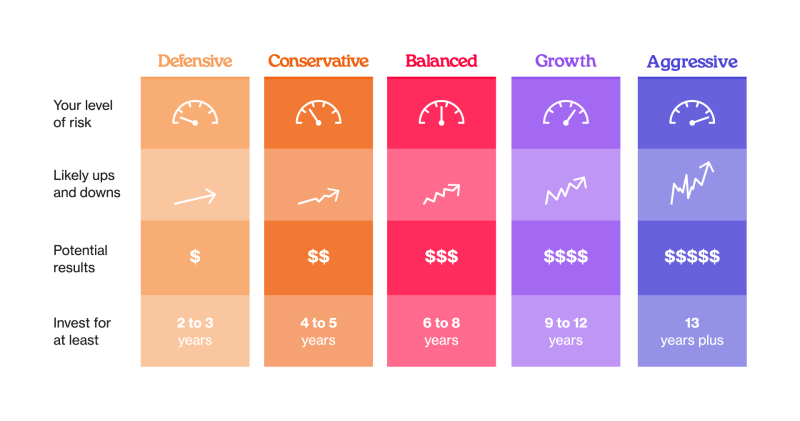
We’ve put the many KiwiSaver funds into five groups based on how much of the more risky investments they hold, like shares and property.
Depending on how long you are investing for and your attitude towards risk, one type (defensive, conservative, balanced, growth, or aggressive) will probably work best for you.
Use our KiwiSaver fund finder to find the right type of fund for you.
2
Compare funds of your type.
Our KiwiSaver fund finder lets you compare KiwiSaver funds and sort them by their fund type, costs and past results.
3
Keep an eye on KiwiSaver fees.
We pay a KiwiSaver provider to manage our money and invest it, and this comes at a cost. But the more fees we pay, the less comes back to us in the end.
Fees for funds are not like the costs of other things we buy. For one thing, we get charged behind the scenes, and we don’t get a monthly bill or invoice. In KiwiSaver, fees add up to tens of thousands over the years, so it helps to compare costs well.
You may decide that paying more is worth it, but it helps to compare the costs of different funds and choose carefully. Not all funds are the same, and none of us wants to pay more than we need to.

Paying more doesn’t necessarily get you more – in fact it can be the exact opposite.
4
Compare the services and support that come with the fund.
For the fees we pay, each KiwiSaver provider invests our money and offers help and communications that help us stay on top of our investing.
Sorted surveys KiwiSaver providers every six months and scores how well they compare.
See our ratings in our KiwiSaver fund finder.
5
Check past performance isn't below average.
Investing in KiwiSaver is all about getting the best results possible (after fees and taxes). The goal is to grow your money as much as you can for a first home or the long term.
Although you can’t predict how a fund will do in the future based on its past, you can see if it has performed consistently compared to the others of the same type.
You can compare returns on our KiwiSaver fund finder.
If all the other funds have done well but the one you’re looking at consistently hasn’t, something may be wrong with it.
So is it time to switch your KiwiSaver?
When you come through our 5 steps, you’ll most likely end up with a shortlist – a handful of funds you’re looking into more closely. At this stage you’ll have other criteria as well, such as how ethical a fund is, whether you like the brand, etc.
Essentially you need to do a bit of a cost-benefit analysis. Is the money you’ll be paying in fees for this fund worth it?
When you find your new fund, it’s easy to switch – either to another fund with your existing provider, or to another provider entirely. If it's with your current provider, you may be able to switch funds online.
If you’re joining another KiwiSaver provider, just contact them directly. You’ll need to fill out a membership application, but they do most of the heavy lifting to get everything in order. They will tell Inland Revenue and arrange for your funds to be transferred, which typically takes between 10 and 35 days.
Within a few weeks your money will be flowing into your new fund for your future.
More KiwiSaver fund FAQs
These days there is a lot of uncertainty about the future. No matter what happens in the world, what you want is a strategy, so that you don’t have to worry about whether your KiwiSaver balance is suddenly up or down. You want to know that you’re on track to hit your goals. (That way you don’t lose sleep.) Being in the right fund gives you the peace of mind to ride things out.
You can, but for most people one is enough. Many times people put a bit in growth and a bit in conservative, and end up with an overall investment mix that is balanced. The underlying investments in the funds can be really similar – it’s just the proportion of growth assets (shares, commercial property, derivatives) that’s different. So it would be easier to keep track of a single balanced fund instead.
No – and this is one of the advantages of KiwiSaver. Having just one provider at a time makes it simpler to keep track of.
After you figure out your fund type and have a shortlist, at this stage you need to look at what’s inside a fund to see whether the investments are ethical and fit your values.
You could have another look at Smart Investor – it’s the first tool that enables you to see the entire list of every investment in each fund. That’s especially good if you want to geek-out on all the information, but happily there is also a simpler way.
Websites such as Mindful Money make it transparent – you can easily see whether the fund you’re thinking of choosing holds investments that are ethically challenged, and check other ethical considerations you may have as well. Check to see what’s inside your fund here.
You may have heard about the advantages of low-cost index funds and looking for a KiwiSaver equivalent. The good news is that many KiwiSaver funds invest in one or more index funds.
You’ll find them when you sort your type of fund by fees, towards the cheapest end of the market. Under many of those low-cost options, you’ll see that their top 10 investments are in underlying funds from Vanguard, for instance. There are plenty to choose from.
At Sorted, we group the funds into five categories in this way:
|
Type of fund |
Proportion invested in 'growth assets' |
|
Defensive |
0–9.9% |
|
Conservative |
10–34.9% |
|
Balanced |
35–62.9% |
|
Growth |
63–89.9% |
|
Aggressive |
90–100% |
There’s more about these five KiwiSaver fund types in the dropdown menus here on Smart Investor.
Here are some good reasons to head down this route:
- You decide you can handle more ups and downs and you want the potentially higher returns of a riskier fund.
- Your fund’s ups and downs worry you too much and you’re thinking about moving to a lower-risk fund.
- You’re planning to withdraw funds for a first home, or getting close to retirement, and want to move to a lower-risk fund to reduce the chances that your balance will drop right before you need the money to spend.
These may be good reasons to move to a new KiwiSaver provider:
- It charges lower fees on funds with the same level of risk.
- It offers better services and clearer communications with its members.
- Your current provider consistently makes returns well below average over the long term.
Don’t choose a new KiwiSaver provider solely on high returns, which will go up and down. Base your decision on their investment options, fees and services.
These are probably bad reasons to jump ship from your current fund:
- You’ve read that another fund has been getting higher returns than your current fund. Investment returns are like waves to ride: they don’t typically stay still, and there’s no point chasing something that’s already gone.
- You’ve read or heard that some other provider’s funds have been making higher returns than your current fund – especially if it’s just short-term returns.
- A new provider has been recommended to you, but the recommendation came from someone who is rewarded if you transfer (like a bank or an adviser). Ask questions about this.
- You’re being pressured to switch over to your bank. A familiar brand – or the convenience of seeing your KiwiSaver balance all the time with your other accounts – isn’t necessarily a good reason to shift.
You won’t believe how much these add up to over time! And since they get charged to us behind the scenes each year, it’s good to take a hard look. You can forecast what you’ll pay in a given fund over the life of your KiwiSaver experience using our KiwiSaver fees calculator. How do your forecast fees compare with other funds? Could you be getting better value? The earlier you have a look, the better choice you’ll make.
It’s time to make a call. We can’t tell you which one to pick, but if you have a shortlist, those funds will undoubtedly each be different in terms of their fees, services and performance. You need to do a bit of a cost-benefit analysis between fees and services (since future performance is hard to predict). Do you think the money you'll pay is worth it? If so, that may be the one for you.
About the author
You may also like...
Guide
Applying for a KiwiSaver hardship withdrawal
In financially stressful times, our minds quickly run to those piles of money in KiwiSaver. Whether it’s rising prices and…

Guide
How KiwiSaver works: your complete guide to making the most of it
Your complete KiwiSaver explainer from the team at Sorted. Learn everything you need to know about how it works and…

Guide
How KiwiSaver can help you get into your first home
Getting on the housing ladder can feel out of reach, but KiwiSaver can bring it that much closer. KiwiSaver was…

Guide
Make the most of KiwiSaver and grow your balance
To make the most of KiwiSaver, you need to make some important decisions along the way.

Video
Use KiwiSaver for your first whare
KiwiSaver can help you save up a deposit for your first home. This free video tells what you need to…



Visit us on social


© Office of the Retirement Commissioner
