Back
Back 










How KiwiSaver works: your complete guide to making the most of it
Reading time: 16 minutes
 Reading time: 16 minutes
KiwiSaver’s an investment of a lifetime, one of the smartest money moves many New Zealanders can make. It’s voluntary and you can opt out, but most of us can benefit from being in it. If you’re 18 or over and start a new job, you’ll be automatically enrolled (with some exceptions). It’s open to people who are over 65 to join as well.
How does KiwiSaver work? It helps you build money for retirement or your first home bit by bit, through contributions from you, your employer (if you have one) and the government. The money that goes in is invested by the KiwiSaver provider of your choice or, if you don’t choose one, a default fund assigned by Inland Revenue. Your fund type determines how your money’s invested and how fast it could grow over time. Our free KiwiSaver calculator might blow your mind with how much it can all add up.
KiwiSaver’s easy because it’s basically all taken care of for you, but there are ways to maximise what you get out of it.
In this guide
How is KiwiSaver different to other savings? 
Why you want to take advantage of KiwiSaver
Okay, so what goes into KiwiSaver?
You can use KiwiSaver for your first home
You can use KiwiSaver for retirement
The 5 basic types of KiwiSaver funds
How to switch KiwiSaver providers
Keeping up your KiwiSaver on parental leave
KiwiSaver is relationship property
About the author

How is KiwiSaver different to other savings?
You might not realise it, but if you’re in KiwiSaver, you’re an investor. Yep, that’s right, your KiwiSaver’s more than just a savings account, it’s a professionally managed investment fund. Your fund manager invests your contributions on your behalf, which earn returns over time.
If you’ve got five minutes to learn more about returns here, spend three minutes watching this video about investing’s secret sauce, and why the sooner you start, the bigger your balance can become.


Why you want to take advantage of KiwiSaver
There are so many benefits that the question is less ‘why’ and more ‘why not?’.
- KiwiSaver contributions come out of your pay before you see it. That makes saving easy.
- It’s generally a lower-cost way to invest in managed funds.
- If you’re employed, your employer has to contribute at least 3.5% (pre-tax) of your gross wage or salary into your KiwiSaver account. That’s on top of your own contributions.
- The government pays into your KiwiSaver account as well, an annual government contribution (if you’re a contributing member aged 18 or over) of up to $260. It’s free money, guys.
- As well as saving for retirement, you can use KiwiSaver to buy your first home through a KiwiSaver first-home withdrawal.
- If you change jobs or leave the workforce, your KiwiSaver account moves with you.
- If you experience hardship, it’s possible to access the funds in your account early.
Okay, so what goes into KiwiSaver?
Your KiwiSaver grows with:
- Your contributions. Employees can choose to automatically contribute 3.5% of your gross (before tax) wage or salary (this minimum will increase to 4% in April 2028). If you want to, you can choose to contribute more: 6%, 8%, 10%. If you’re not an employee, you can still contribute to KiwiSaver directly to your KiwiSaver provider or through Inland Revenue.
- Employer contributions. If you contribute, your employer is also required to put in at least 3.5% of your gross salary until you’re 65 (this is also increasing to 4% in April 2028). Good news as of April 2026: 16- to 17-year-olds qualify for employer (and government) contributions too.
- Government contributions. There’s also an annual government contribution of up to $260 each year (until you’re 65) for everyone who contributes, whether you’re an employee or not. (There’s more on this below.) Heads-up for higher earners: from July 2025, people earning more than $180,000 aren’t eligible to receive the government contribution.
- Investment returns from all the contributions being invested for you by your KiwiSaver provider. More on those below.
- Any additional money you choose to put in. You can make voluntary contributions – lump sums or regular automatic payments – at any time.


Yes, your money is safe!
KiwiSaver’s regulated by the Financial Markets Authority (FMA). All KiwiSaver providers have to meet strict standards. If something goes wrong with yours, you have formal protections and people to help. KiwiSaver money is kept in a trust and ring-fenced from the finances of your KiwiSaver company, so even if it goes belly up, your money would be protected.
Why do your employer contributions look like less?
It looks fishy, but don’t worry, it’s not. Even though you and your employer are both contributing the same percentage (3.5%), your employer’s amount may appear smaller in your account. That’s because employer contributions are taxed. It’s called the Employer Superannuation Contribution Tax, and it’s deducted automatically.
Is the employer contribution included in your salary or on top of it?
Whether your employer’s contribution is included in your salary or in addition to it depends on your employment contract. Most employers pay KiwiSaver on top of your salary, but some include it as part of a ‘total remuneration’ package, which means it comes out of your agreed salary, rather than being added. If you’re not sure, check your contract or ask HR.
If contributing more is a stretch for you right now, you can apply to Inland Revenue for a temporary rate reduction and keep yours at 3% for a while. Here’s the info you need.
You can use KiwiSaver for your first home
When buying your first whare, you may be able to make a one-off withdrawal of most of your KiwiSaver savings, as long as you’ve been a member for at least three years. You also may even qualify if you’ve previously owned property.
Get amongst our KiwiSaver calculator to find out how much you’re on track to save.
The Kāinga Ora website has more information on using KiwiSaver for a first home.
Also, get the rundown from this two-minute video and be inspired by this blog.


“Buying our first house [using KiwiSaver] felt great. I didn’t realise how much it would benefit me and my life until it happened.”
– shared with Sorted
You can use KiwiSaver for retirement
If you’re using KiwiSaver to save for retirement, you can’t touch your money until the age you get NZ Super, which is currently 65. In just a few seconds, our free KiwiSaver calculator can show you how much you could have by then.
If you’re still working at 65, you can keep your KiwiSaver account open and your investment doing its thing. Your employer doesn’t have to keep contributing, but they can choose to. The government will no longer pay its contribution, since over-65s are typically eligible for NZ Super.
When it’s time to withdraw your money, how fast you open the tap is up to you. Keep it turned off and leave your money invested, or open it slightly to drip-feed you some income. Our retirement navigator can help you find your sweet spot, and talking to a financial adviser about your needs and risks is often a good idea too. Here’s how to find one.
There’s no rush. You can leave your money where it is while you work through all the issues and decide. For example, if you want to make regular withdrawals, there may be a minimum amount required or some fees. Contact your KiwiSaver provider to find out what the deal is.
The 5 basic types of KiwiSaver funds
The type of fund your KiwiSaver contributions are invested in shapes how your money grows. To make it easy to understand, we’ve grouped the hundreds of funds into five types based on how much of the more risky investments they hold, like shares and property.
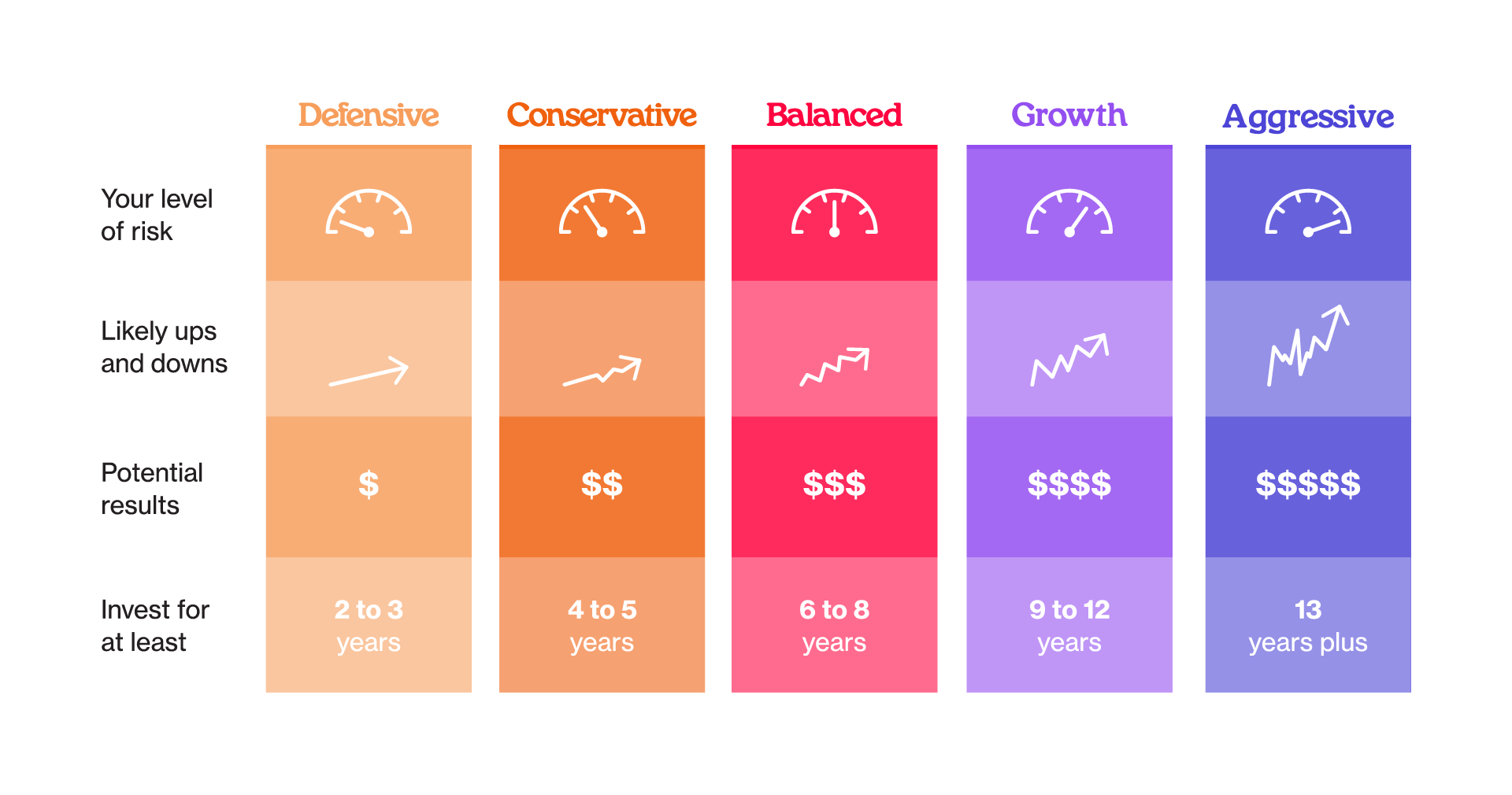
As a general guide, the longer it’ll be before you use the money, the more risk you can usually afford to take, because you’ll have time to ride out the ups and downs. If you’ll need the money soon (for a first home in the next year or two, say), a lower-risk fund will probably suit you better.
Our free KiwiSaver fund finder tool compares funds by type, fees and returns, and this guide is here to support you to narrow down the right fund for you.
How to switch KiwiSaver providers
1
Find out who your current provider is.
There are loads of private KiwiSaver providers, including banks and investment companies, who manage the schemes. To suss yours out, call Inland Revenue on 0800 KIWISAVER (0800 549 472 837) or visit the website and log in to myIR.
2
Choose your new provider and fund.
It’s easy to change funds, but it’s not always the best idea. Before switching, compare fees, fund performance and the services offered by providers by using the KiwiSaver fund finder and this guide on what to look for. The quick fund type quiz in step 2 of our 6 Steps can also help narrow things down.
Your reasons for changing should be based on building your long-term balance. If you'd like some professional advice, speak to a financial adviser who specialises in KiwiSaver.
3
Contact the new provider directly.
You can apply to join them straight away; you don’t need to know your current provider first, and you don’t need to contact your old provider. The new one arranges the transfer.
“I learnt more about what KiwiSaver is and that knowledge helped me to find a different provider more aligned to my values and with a much smaller fee.”
– shared with Sorted
Keeping up your KiwiSaver on parental leave
Your wallet might take a hit when you become Mum or Dad, but your KiwiSaver doesn’t have to. Finding ways to get as many dollars as you can continuing to work for you both is key.
Your employer isn’t required to contribute during your paid parental leave, but some do if you do. Your contributions are optional, but if you keep up your contributions, Inland Revenue will make employer contributions and keep you on track for your government contribution too.
If money’s tight during leave, a savings suspension or rate reduction lets you temporarily off the hook or reduce your contributions.
KiwiSaver is relationship property
One thing many people don’t know is that KiwiSaver is relationship property. That means if you and your boo split, your KiwiSaver balance can be taken into account in a relationship property settlement. Yikes. It’s worth being aware of, especially if your balance is significantly larger or smaller than your partner’s.
Check out what you’re on track to have
Want to see the magic of compound interest in action? Enter your age, salary and contribution rate into the KiwiSaver calculator and get a personalised projection in a flash. You can also play around to see the effect of changing your contribution rate or fund type. Even a small tweak can make a big difference over the years.
“I changed my KiwiSaver provider and upped my risk tolerance based on your calculators.”
– shared with Sorted
KiwiSaver FAQs
Who gets my KiwiSaver if I die?
Much like everything else you own, it becomes part of your estate and is distributed according to the instructions you leave in your will. It’s important to have a will drawn up now, just in case. Without one, the government will use a formula to split up your assets. To help you make sure your wishes are followed, here’s more about wills.
What’s the tax rate on KiwiSaver?
There are three prescribed investor rates (PIRs) in KiwiSaver: 10.5%, 17.5% and 28%. It’s a good idea to make sure your rate’s correct so you’re not paying more tax than you should be. If your income is sometimes or always less than $48,000 each year, you may be paying too much tax in KiwiSaver. It’s simple to correct this: just tell your KiwiSaver provider.
Are KiwiSaver withdrawals taxed?
Nope. When you take out your KiwiSaver money, for a first home, financial hardship, or to live on in retirement, the money is tax-free. Your KiwiSaver contributions are made after your income has been taxed. The gains from your investments that you own in KiwiSaver are taxed as well, but when you withdraw for a first home or retirement at age 65, it’s all your money to use. To withdraw your KiwiSaver money, contact your provider.
Who can join KiwiSaver?
To be able to join KiwiSaver, you don’t have to be employed, but you do have to be a New Zealand citizen or entitled to live in Aotearoa indefinitely, and living or normally living here. Find out more about who can and can't join KiwiSaver on the Inland Revenue KiwiSaver site.
How do I join KiwiSaver?
There are three ways: automatic enrolment when starting a new job, opting in through your employer, opting in through a KiwiSaver provider. You can opt out within the first two to eight weeks of starting a job if you want to.
Self-employed? Not currently working? No worries, just contact a KiwiSaver provider to sign up and arrange a regular contribution. For more on how to join and a list of KiwiSaver providers, see the Inland Revenue KiwiSaver website.
Can I quit KiwiSaver?
If you were automatically enrolled, you can opt out, but only between two and eight weeks of starting a job. If you signed up yourself – either through your employer or through a KiwiSaver provider – you’ll have to contribute for at least 12 months. If you’re 18 or younger and have been incorrectly enrolled, you can opt out through Inland Revenue.
Is it bad to be in a KiwiSaver default fund?
No, not necessarily. They exclude investments in fossil fuels and illegal weapons, cost significantly less than other funds, have a balanced investment mix, and offer a high level of service to their members. But since balanced funds aren’t right for everyone, default funds won't be either. To make your choice of whether to be in a default fund, first find out which type of KiwiSaver fund will work best for you.
When can I access the money in my KiwiSaver?
You can get your hands on your cash (or some of it) at age 65, to help you buy your first home, if you’re experiencing significant financial hardship, if you’re moving overseas permanently to a country other than Australia, if you’re facing a life-shortening illness and in a few other situations. There’s more about this on Inland Revenue’s KiwiSaver site.
How does the government’s KiwiSaver contribution work?
Each year, if you’re eligible and contributing, the government adds 25 cents for every dollar you put in, up to a maximum of $260 a year. To get the full amount, you need to contribute at least $1043 of your own money over the KiwiSaver year (1 July to 30 June). It’s essentially free money towards your retirement, so it’s worth making sure you’re contributing enough each year to get the full government contribution, if you can.
What happened to the 3% contribution rate?
Starting 1 April 2026, the default KiwiSaver contribution rate was increased from 3% to 3.5% for both employees and employers. A further increase to 4% is planned for 1 April 2028. If the increase is making it hard to make ends meet, you can apply to Inland Revenue for a temporary rate reduction. Here’s how.
How do I check my KiwiSaver balance?
Contact your KiwiSaver provider. Most have an online portal or app where you can see your balance and contribution history. If you’re not sure who your provider is, head to the Inland Revenue website and log in to myIR. Your provider will be listed there.
Is KiwiSaver worth it?
KiwiSaver combines several advantages that are pretty cool: your employer contributes, the government adds money each year, and along with your contributions it’s all invested to grow long term. For many people, that combo makes it one of the most effective ways to build wealth for the future.
Are KiwiSaver funds guaranteed?
KiwiSaver is not guaranteed by the government. It is, however, administered by Inland Revenue (which helps make sure it works properly) and overseen by the FMA (which makes sure KiwiSaver companies behave themselves and do right by you). It's important to remember that KiwiSaver providers are private companies, like any banks we use. Here are some more fast KiwiSaver facts.
Is it hard to switch my KiwiSaver?
No, it’s easy as, about the same as switching your mobile or power provider, actually. You let your new company know you want to move to them, and they do all the work behind the scenes. There are two ways of switching with KiwiSaver: staying with your provider but moving to one of their other funds, or moving to a new provider. There are good reasons to switch, such as when you’re getting closer to the time you plan to start spending your KiwiSaver money on a first home or in retirement. There are also bad reasons to switch, such as because you heard about some other fund doing better than yours. Don’t switch KiwiSaver funds without reading this.
Where can I go for more help?
- Inland Revenue’s KiwiSaver webpages for everything there is to know about the KiwiSaver scheme
- Kāinga Ora’s home ownership webpages on using KiwiSaver to help buy a first home
- KiwiSaver providers or financial advisers for investment advice
- The Financial Markets Authority website for KiwiSaver regulations and international transfer information
About the author
You may also like...
Blog
Top 5 KiwiSaver myths worth debunking right here and now
Let’s unpack some of the most common KiwiSaver myths, and why it’s smart to be contributing as much as you…

Guide
How to pick the right KiwiSaver fund
Even if you’ve been in KiwiSaver for a while, your fund may not be a good fit.

Guide
Make the most of KiwiSaver and grow your balance
To make the most of KiwiSaver, you need to make some important decisions along the way.

Guide
How KiwiSaver can help you get into your first home
Getting on the housing ladder can feel out of reach, but KiwiSaver can bring it that much closer. KiwiSaver was…

Blog
The motherhood penalty and ways to work around it
Understand how to mitigate the economic and professional disadvantages many working mothers face by using these practical financial and career…

Guide
KiwiSaver hardship withdrawals: can you get your money out early?
There are alternatives to KiwiSaver hardship withdrawals that are better for your bottom line. Here’s how to free up cash…

Video
Use KiwiSaver for your first whare
KiwiSaver can help you save up a deposit for your first home. This free video tells what you need to…